
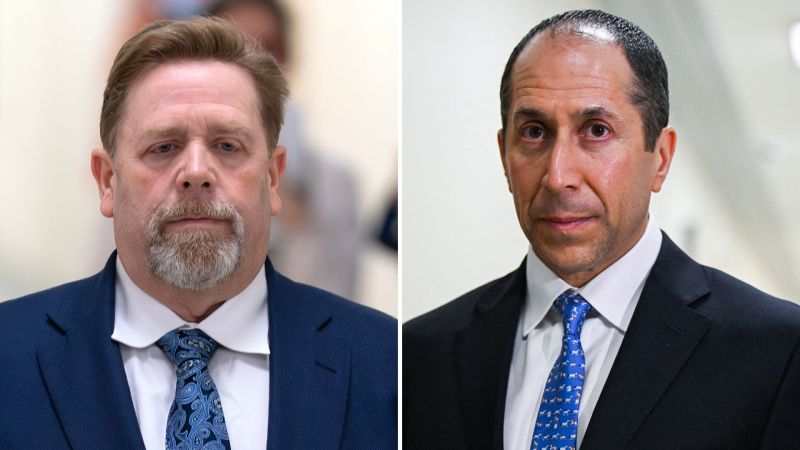
The House Oversight Committee released videos Tuesday of closed-door depositions with two men in Jeffrey Epstein’s inner circle as part of its probe into the late convicted sex offender.
Darren Indyke, a longtime Epstein employee and attorney, and Richard Kahn, Epstein’s longtime accountant, appeared before the committee earlier this month to answer questions from both Democrats and Republicans about their long relationships with Epstein and how the disgraced financier made and spent his money. Both denied prior knowledge of Epstein’s crimes and currently serve as co-executors of Epstein’s estate.
Neither had been formally questioned by federal law enforcement about their working relationships with Epstein before their depositions with the House Oversight Committee earlier this month.
Here are the takeaways from their appearances on Capitol Hill.
Kahn and Indyke each stated that they were unaware of Epstein’s crimes, despite having worked for Epstein for decades and being intimately involved in Epstein’s business dealings and finances. Both men said if they had known about Epstein’s trafficking of women and girls while working for him, they would have cut ties with him immediately.
“Let me be clear: I had no knowledge whatsoever of Jeffrey Epstein’s wrongdoings,” said Indyke, who began working for Epstein in 1996. “My complete lack of involvement in that misconduct is a matter of record. Not a single woman has ever accused me of committing sexual abuse or witnessing sexual abuse, or claimed at any time that she or anyone else reported to me any allegation of Mr. Epstein’s abuse.”
“There was nothing that I saw that would lead me to believe he was engaging in misconduct,” Indyke added later in the deposition.
Indyke said he only spoke with Epstein about “legal advice” on his business matters like acquisitions, real estate and investments, and that he never spoke with Epstein about “social relationships.”
Indyke also said he was aware that Epstein had sex with “underage people” in Florida but that his understanding was that it was “limited to Florida” and Epstein told him he “wasn’t going to be in that position again. He was by all counts a very smart man.”
Indyke said he spoke with Epstein in the couple of days before his death in prison, but he would not disclose what they spoke about, saying the discussion was “privileged” and “not personal,” adding that it was “based upon his being in jail at the time, and it was regarding subjects that one would talk about like bail and things like that.”
Kahn began working for Epstein in 2005 as his accountant. He testified that he only saw Epstein approximately every three weeks: “We did not interact socially, and I never attended any of his parties of his social functions. While Epstein was alive, I never observed any sexual abuse or trafficking of women and never received a complaint – either by one of Epstein’s victims or anyone else – of such abuse or trafficking.”
Kahn recalled speaking with Epstein when Epstein was first charged with a sex crime in the mid-2000s and said Epstein reassured him at the time.
“Going back to when I originally spoke to Epstein when he first was being charged with soliciting a minor for prostitution, he told me that this was a mistake and it would never happen again that he would be with a minor,” Kahn testified. “I never saw minors around Epstein, so I was never suspicious that Epstein was with minors.”
He added, “If I knew back then that Epstein was not keeping his word and not honest, and abusing women, I would have left work and reported him to the authorities.”
Kahn said he “didn’t see anything out of the ordinary” in regard to Epstein’s interactions with women.
Democrats emerged from both depositions saying they did not find the mens’ consistent denials credible given their proximity to the convicted sex offender.
As co-executors of Epstein’s estate, Kahn and Indyke have set up a victims’ compensation fund, which says it distributed approximately $125 million to eligible applicants before winding down in 2021.
During the 2008 investigation, Indyke said that on “one or two occasions,” defense counsel asked him to call people who were “concerned that law enforcement was calling them” to remind them that a lawyer could be provided to them if they wanted and that they didn’t have to speak to investigators if they didn’t want to. But, Indyke added, “I never told them not to speak to anyone.”
Asked by a member if he settled any claims associated with Epstein’s crimes, Indyke said, “There was a list of people that the government provided, and I believe there were a number of those people that filed claims against Epstein and those claims were ultimately settled, yes.”
Responding to a follow-up question, Indyke said the claims were settled in 2009-2010, not after Epstein’s death.
A member then argued Indyke would have understood the depths of Epstein’s crimes in order to settle the claims, which Indyke disputed: “So that we’re clear, people settle claims for all kinds of reasons, including the cost of litigating, the time spent litigating, how much it interferes with your current business.”
Indyke added he thought some of the allegations in some claims were not accurate.
Kahn shared that he initially did not want to take on the role as a co-executor of Epstein’s estate but did so in part to help the women abused by Epstein.
“That’s not a role that anyone would want,” he said, adding he took the role in part to “compensate victims for all of their harms that they endured by Epstein.” He said that “was my top priority in taking this role after learning about all the terrible things Epstein did.”
California Democratic Rep. Ro Khanna asked Kahn if the Epstein compensation fund settled a claim with “Jane Doe 4,” a woman who accused President Donald Trump and Epstein of sexual assault while she was a teenager in the 1980s.
Trump has consistently denied wrongdoing and has not been charged with any crime in connection with Epstein.
Kahn initially testified he believed Jane Doe 4 received a settlement from the Epstein estate through mediation in 2025, but he added, “I don’t have any recollection of her making allegations against President Trump.”
In the last few minutes of the deposition, when asked by a Democrat if they could share more on this settlement, Kahn’s lawyer said he may have been mistaken about Jane Doe 4 receiving a settlement.
The deposition then went off the record so that the lawmakers could identify Jane Doe 4 by name.
When they returned back to the deposition on the record, Kahn’s attorney said, “The name that was provided to us in confidence, or off the record, as to Jane Doe 4’s last name, is not a name that neither I or Mr. Kahn is familiar with. We do not recognize that individual to be someone who has brought claims against the estate or that we have mediated with and resolved a case.”
Acting as Epstein’s attorney, Indyke withdrew thousands of dollars in cash from various accounts at a time on Epstein’s behalf, sometimes drawing scrutiny from banks.
In his deposition, Indyke said even in retrospect he did not see Epstein’s movement of large sums of cash as a sign that Epstein was trafficking women and girls “given the size and scope of Epstein’s households and the number of people involved” with various projects at a given time.
“The cash that was being asked from me seemed to be for legitimate purposes and I had no reason to think that they weren’t for legitimate purposes,” Indyke said.
Indyke also testified that Epstein paid for his wife’s infertility treatments.
When asked about loans extended to him by Epstein, Indyke said that Epstein was “generous to many of his employees” and that the loans were never used to “justify large movements of money” or to “make illicit funds appear illegitimate.”
Indyke was such a close confidant to Epstein that upon his death, a copy of Epstein’s trust shows he planned to leave Indyke $50 million. That is a number matched only by Epstein’s girlfriend, Karyna Shuliak, who was due to receive $50 million as well.
The will also showed that Epstein planned to leave Kahn $25 million.
When asked why he thought he was left so much money, Kahn replied that Epstein knew his estate would take “many, many years of work” and that Epstein did not provide an executor fee in the estate, which would have amounted to a roughly $12 million fee.
“That could be the only reason why he left me such a large bequest because if you take away the $12 million, my bequest is not different than many other individuals that are in that trust for $10 million,” Kahn testified.
As Epstein’s accountant, Kahn said he had “no role in setting up any of Epstein’s companies.” At the time of Epstein’s death, he had somewhere between $500-600 million in assets, Kahn said.
Source: edition.cnn.com

