
A decade ago, Jessica Luebbers could not have imagined supporting Marco Rubio for president. His acrimonious race to stop Donald Trump’s march to the White House in 2016 left a bitter taste in her mouth.
But as she and hundreds of other Trump supporters gathered outside Dallas this week at the Conservative Political Action Conference to consider the future of the movement, Luebbers said she hoped the president would pass the torch to his former rival in 2028.
“I was a little skeptical when Trump picked Rubio (for secretary of state) but, man, he has knocked it out of the park,” Luebbers said. “It’s amazing how much he’s had on his plate.”
The growing comfort with Rubio among conservatives was captured in CPAC’s annual straw poll of potential 2028 contenders. After barely registering in the informal survey last year, 35% of attendees at this year’s event said they wanted him to be the party’s next nominee, according to results released Saturday.
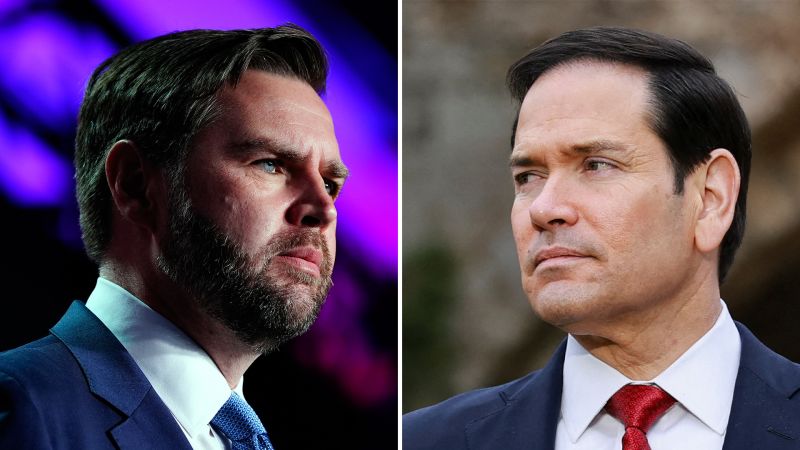
Rubio trailed only Vice President JD Vance, who won the CPAC straw poll for the second time with 53%, albeit with less support than in 2025, when he won 61%.
The straw poll is not a scientific survey, with a pool limited to conference attendees, and is not representative of the broader Republican electorate. But the result is certain to further fuel Republican Party intrigue over the budding rivalry between two top Trump confidantes. Rubio has taken a leading role for the administration amid Trump’s increasingly aggressive military posture and high-stakes diplomatic negotiations in Venezuela, Iran and Cuba.
Vance, meanwhile, has lately operated more often from behind the scenes. His past statements loudly opposing new foreign conflicts has left some Trump supporters wondering where he stands on the decision to strike Iran and kill many top regime officials, including Supreme Leader Ali Khamenei.
Some younger conservatives who voiced opposition to Trump’s war seemed to prefer Rubio to Vance – despite the secretary’s historically hawkish positions.
“I may disagree with him on something like the Iran war and how he’s spoken about that, but then I can agree with him on some other policies,” said Luke Rosati, a student at Xavier University.
He added: “I hate seeing the president and vice president run. I want someone new and different.”
Still, Vance has many supporters within the GOP base who were eager to punch his name in the CPAC straw poll. His backstory as the son of a drug addict raised by his grandmother – chronicled in his best-selling book “Hillbilly Elegy” – remains compelling to his followers.
“I think he speaks to a lot of people in the country that maybe other people in the country would pass off,” said William Augustine, who lives in the Dallas area and attended CPAC with his wife Susan.
The debate over the party’s future took place without its most influential voice: Trump, who skipped the conference for the first time in a decade. Trump has publicly avoided picking an heir, though he has praised both Vance and Rubio. Among the CPAC faithful, his endorsement will ultimately loom large over the nominating contest, should he decide to play kingmaker.
“Certainly, President Trump’s endorsement will play a big role because he needs to continue his legacy,” said Henry Tian of Texas. “Four years is not enough.”
There remain some holdouts, too, who want to see Trump run again despite the Constitution making clear that wouldn’t be allowed.
“We need Trump. We need this to keep going,” said Frank Robles of Paso Robles, California, who wore a Trump 2028 hat to CPAC. “We can’t stop the momentum.”
Vance has largely dismissed 2028 chatter, while Rubio has said he would support the vice president if he runs. Most notable Republican figures have avoided publicly teasing a presidential bid, though Kentucky Sen. Rand Paul told CBS he was considering running again and Florida Gov. Ron DeSantis didn’t rule it out in a recent interview with Sean Hannity.
None of the aforementioned spoke this week at CPAC, which has traditionally served as a platform for future presidential contenders to introduce themselves to the GOP base. This year, few of the rumored 2028 hopefuls made the pilgrimage to Texas.
One exception was the state’s junior senator, Ted Cruz, who received a warm welcome as he laid out his vision for the GOP – one that combines Trump populism and blue-collar support with bedrock GOP principles like small government, low taxes and limited regulations.
“The people who say, ‘We’re conservative, but we’re big government conservatives,’ I’m here to tell you, you’re not being a populist, you’re advocating for the policies of Bernie Sanders and Elizabeth Warren,” Cruz said.
The message resonated with Barbara Lewis, a Texas retiree who said she hopes her home-state senator runs for president again in 2028.
“I just think he’s done a good job for Texas,” she said.
Cruz, though, didn’t get a home-court advantage in the CPAC poll. His support registered at 1%.
Nor did the event’s final speaker, Secretary of Health and Human Services Robert F. Kennedy Jr., find much interest inany future political ambitions. His support in the poll was 0%.
In fact, no one outside of Rubio and Vance surpassed 2% in the survey, which included about 1,600 participants. Many are already looking ahead to a Vance-Rubio ticket – preferably in that order for Maxine Cunnyngham of Edmond, Oklahoma.
“They are the men for the hour,” she said, “and they are positioned right now in the government where they are learning everything they don’t already know and they are going to be perfect.”
Susan Augustine offered another idea.
“They’d make a good team,” she said. “Too bad they couldn’t co-president, you know?”
Source: edition.cnn.com

